
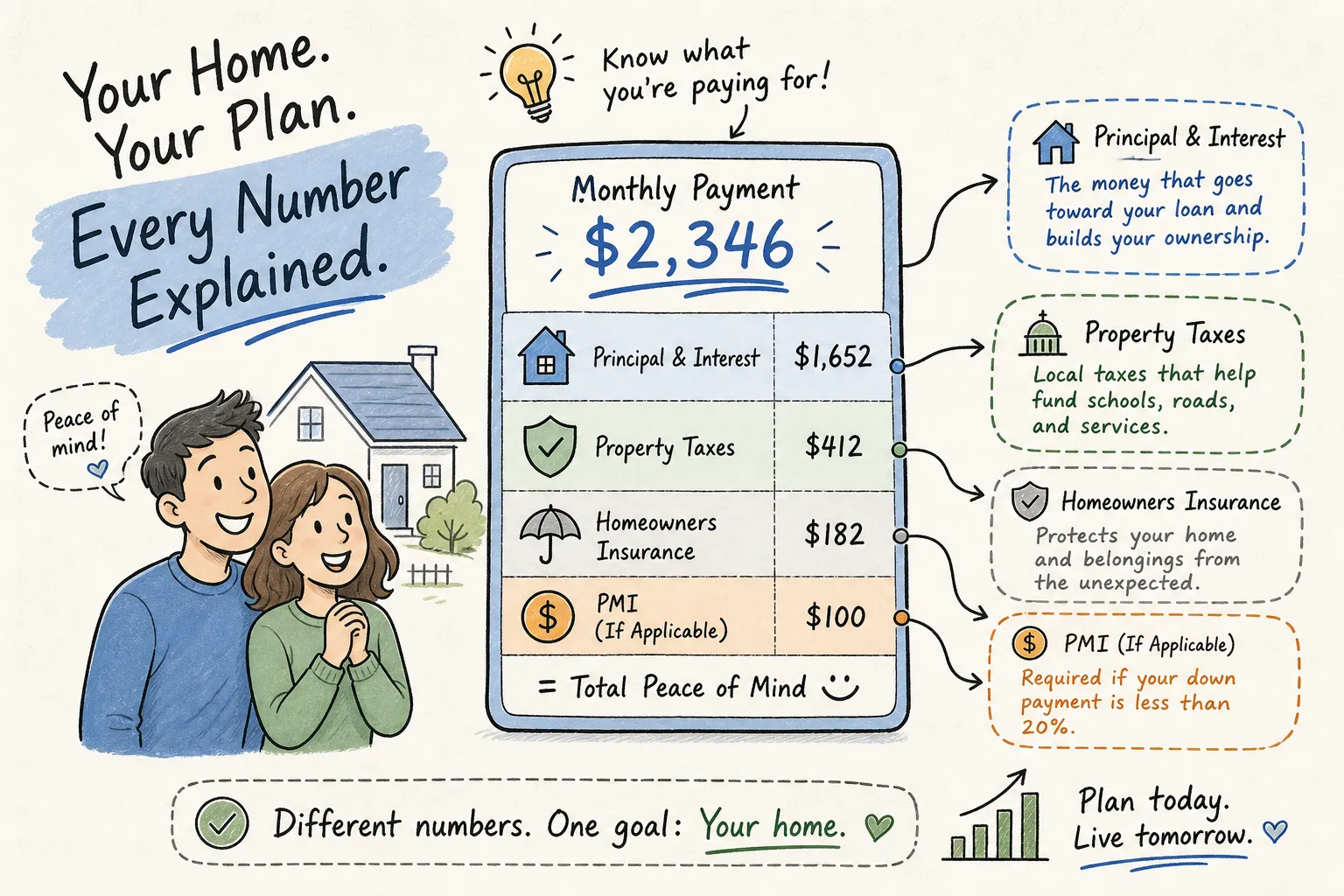
Most first-time buyers fixate on the home price and assume that number tells the whole story. It doesn’t. A $400,000 home doesn’t produce a $400,000 payment obligation; it produces a monthly number built from at least five separate cost layers, each one calculated differently and each one capable of moving your budget significantly. That gap between sticker price and real monthly cost is where a lot of buyers get blindsided. A mortgage payment calculator closes that gap by translating the purchase price into a true all-in monthly figure before you ever make an offer.
This guide walks you through every component of a mortgage payment, explains the math the calculator uses behind the scenes, shows you how to enter your numbers accurately, and gives you the scenarios worth running before you commit. By the end, you’ll know exactly what your monthly payment estimate means and what to do with it.
Table of Contents
What actually makes up your monthly mortgage payment
The shorthand is PITI: principal, interest, taxes, and insurance. Each piece is calculated separately and then combined into the single monthly figure you see on a mortgage payment calculator output or a loan estimate document.
Principal is the slice of each payment that directly reduces your loan balance. Interest is charged on the remaining balance each month, which means it’s heavily front-loaded early in the loan. Taxes are your annual property tax bill divided into 12 equal installments, typically collected by your lender and held in an escrow account until the bill comes due. Homeowners insurance works the same way: your annual premium is split into monthly installments and paid out from escrow. On a $400,000 loan at 6.66%, principal and interest alone run about $2,568 per month. Property taxes and insurance push that number materially higher depending on where you live and what coverage you carry.
PMI and HOA: the two costs buyers forget to budget
Private mortgage insurance, or PMI, applies when your down payment is below 20% of the purchase price. Lenders require it because a lower down payment means higher risk for them. PMI is calculated as an annual percentage of the loan amount and divided by 12 for your monthly cost. At 90% LTV, that rate typically falls somewhere between 0.15% and 0.70% annually depending on your credit score; at 95% LTV, it can range from 0.19% to 1.20%. On a $400,000 loan, even a 0.5% PMI rate adds about $167 per month to your payment.
HOA fees apply to condos, townhomes, and planned communities. Unlike PMI, HOA fees are a flat monthly figure set by the homeowners association and added directly to your total housing cost. The good news on PMI: federal law requires conventional lenders to cancel it automatically once your loan balance reaches 78% of the original home value. Tracking that milestone on a mortgage amortization calculator or schedule is worth the effort.
How a mortgage payment calculator does the math behind the scenes
The formula for a monthly principal-and-interest payment looks intimidating written out, but the logic is straightforward. The calculator takes your loan amount (P), converts your annual interest rate to a monthly rate by dividing by 12 (r), and converts your loan term in years to total monthly payments by multiplying by 12 (n). It then runs those three numbers through the standard amortization formula to produce your fixed monthly payment. You don’t need to memorize it, understanding why those inputs matter is what counts.
The output is a fixed payment amount that stays constant every month for the life of the loan on a fixed-rate mortgage. What changes each month is how that payment splits between principal and interest, and watching that shift is where the mortgage amortization calculator becomes genuinely useful.
Why early payments feel like you’re not making progress
Each month’s interest charge is calculated on whatever the remaining balance happens to be at that moment. In year one of a 30-year loan, that balance is enormous, so most of your fixed payment goes to interest rather than to reducing what you owe. As the balance shrinks over time, a progressively larger share of each payment shifts to principal. That’s amortization in action. To illustrate: on a $400,000 loan at 6.66%, standard amortization math puts the 50% payoff point at roughly year 21 of a 30-year term, a figure you can verify by scanning forward on any amortization schedule.
The amortization schedule makes this visible. It’s a month-by-month table showing your running loan balance alongside each payment’s exact split between principal and interest. It also reveals a useful milestone: the crossover point where the principal portion of each payment exceeds the interest portion. That’s a meaningful marker for tracking real progress on your debt.
How to fill in the mortgage payment calculator accurately
Start with the loan amount, which is simply the home price minus your down payment. A $500,000 home with 10% down means a $450,000 loan. For the interest rate, use a rate you’ve been quoted by a lender. If you don’t have a quote yet, 6.66% for a 30-year fixed is a reasonable mid-2026 benchmark to start with. For the loan term, 30 years lowers your monthly payment but costs significantly more in total interest; 15 years raises the monthly obligation but eliminates years of interest payments.
The calculator at All-in-One Free Online Calculators accepts inputs for all of these alongside taxes, insurance, PMI, and HOA, so the result you get reflects a true all-in monthly cost rather than just principal and interest. Running your numbers there while working through this guide gives the remaining sections a lot more traction.
Taxes, insurance, and PMI: what to enter if you don’t know your exact figures
If you don’t know your local property tax rate yet, the national average effective rate sits around 1.03% to 1.10% of home value annually based on 2025, 2026 state-by-state data. That’s a workable placeholder, though rates vary significantly by state, New Jersey runs above 2%, while California is around 0.70% and Hawaii is near 0.30%. Homeowners insurance currently averages roughly $2,490 per year for $400,000 of dwelling coverage nationally based on 2026 industry aggregator data, but it can run higher or lower depending on your location, home size, and coverage level.
For PMI, if you’re putting less than 20% down, estimate 0.5% of the loan amount annually as a conservative starting point. That will give you a reasonable floor for what to expect, and you can refine it once you have an actual quote from a lender.
Reading your results without getting overwhelmed
A well-built calculator returns a total monthly figure alongside a line-by-line breakdown: principal, interest, taxes, insurance, PMI if applicable, and HOA if applicable. The principal-and-interest line is the core loan cost. Everything else is real, but each line item carries different flexibility: PMI is eliminable once your loan balance hits 78% of the original home value (a federal requirement on conventional loans); homeowners insurance premiums can shift at renewal but aren’t optional; and property taxes are set by local authorities, meaning they can change through reassessment but aren’t directly in your control. Focus on the total first to confirm it fits your budget, then look at the breakdown to understand what’s driving it.
Pay attention to the interest-to-principal ratio on day one. On a $400,000 loan at 6.66%, the first payment sends roughly 78% toward interest and only 22% toward principal, a split that’s typical for a 30-year fixed and consistent with standard amortization math. That’s not a flaw in the math; it’s how amortization works. Knowing it upfront prevents the frustration of checking your balance after two years of payments and wondering why it barely moved.
What the amortization schedule actually tells you
Beyond the monthly split, the schedule shows your running loan balance month by month. Scan forward to the midpoint and you’ll see exactly how much of the balance remains at year 15 of a 30-year loan. For most borrowers, it’s well above 50% of the original amount. That front-loading is also why extra payments made early in the loan have an outsized effect on total interest paid.
Look for the crossover point in the schedule where your monthly principal payment exceeds your monthly interest payment. On a 30-year loan at current rates, that shift happens somewhere in the back half of the loan. Tracking that date gives you a concrete milestone to aim for, and a reason to consider extra payments if you want to get there sooner.
Scenarios worth running before you make an offer
The real power of a mortgage payment estimator isn’t a single calculation. It’s the ability to run comparisons quickly and see how each variable moves the needle, which is exactly what a mortgage affordability calculator approach gives you before you ever sit down with a lender.
Rate sensitivity matters more than most buyers realize. On a $400,000 loan, a 0.10 percentage-point increase in rate adds roughly $22 per month to your payment. A 0.50% rate difference compounds into tens of thousands of dollars in total interest over a 30-year term. That’s the financial case for rate shopping before you lock. On a $500,000 loan, a 0.10% move costs about $28 per month, small in isolation, significant over 360 payments.
The 30-year versus 15-year comparison is worth running with your actual numbers. At current benchmark rates (30-year at approximately 6.66%, 15-year at approximately 6.08%), a $400,000 loan runs about $2,568 per month on the 30-year term versus roughly $3,395 per month on the 15-year term. The monthly gap is about $827, but the 15-year loan builds equity dramatically faster and eliminates more than a decade of interest payments. Whether that tradeoff makes sense depends entirely on your income and other financial priorities.
Extra payments are the third scenario worth modeling. Adding $200 per month in extra principal to a typical 30-year mortgage can save roughly $115,000 in total interest and cut nearly six years off the loan term. Biweekly payments, which produce 26 half-payments per year instead of 12 full payments, effectively add one extra payment annually. That single extra payment per year can shorten a 30-year loan by several years and save tens of thousands in interest, depending on the rate and balance.
Using your estimate to prepare for lenders
Once you have a reliable payment estimate, the next step is checking it against your income. Lenders evaluate the debt-to-income ratio (DTI), which compares your total monthly debt obligations to your gross monthly income. A strong position is 36% or below; most conventional lenders will approve up to 45% with solid credit and reserves, and some automated underwriting systems accept up to 50%. If your mortgage payment estimate pushes your DTI past those thresholds, the calculator has just told you something important: the price, the down payment, or your existing debt load needs to change before you apply.
Three levers move your monthly payment in a meaningful way. The loan amount is controlled by your down payment and the purchase price you negotiate. The interest rate is influenced by your credit score and which lenders you shop. The loan term changes the monthly payment versus total interest tradeoff. Hitting 20% down eliminates PMI, which frees up $100 to $200 per month on a mid-range loan, real money worth engineering for if you’re close.
Know your number before you walk into any conversation
A mortgage payment calculator isn’t just a number machine. It’s a decision-making tool that surfaces the true cost of a home purchase before any commitment is made, before any offer is written, and before any lender pulls your credit. Understanding each component- principal, interest, taxes, insurance, PMI, HOA- and knowing how to run scenarios for different rates, terms, and down payment sizes puts you in a fundamentally stronger position than buyers who walk in without that preparation.
If you haven’t run your numbers yet, the free calculator at All-in-One Free Online Calculators takes about 60 seconds and requires nothing but basic loan details. Run the mortgage payment calculator with a few different scenarios while you’re there: try a 15-year term, bump the rate up a quarter point, see what an extra $200 per month does to your payoff date. Each scenario teaches you something the home price alone never could.
Knowing your payment estimate doesn’t commit you to anything. It does something more valuable: it makes the entire home-buying process less stressful and more grounded in real numbers from the start.
